

7 Japanese Lifestyle Habits That Can Support Healthy Weight Management:When people think about losing weight, they often imagine strict diets, intense workouts, calorie counting, and giving up their favorite foods.
But sustainable weight management doesn’t always require extreme measures.
Many Japanese lifestyle practices focus on something much simpler: how you eat, how you move, and the small choices you make every day.
The idea is not to follow a restrictive diet or look for quick results. Instead, it is about developing habits that can be maintained for years.
Read: Tea Kettle : Why you need and Improvements
Here are seven simple Japanese-inspired habits that can support healthier eating and long-term weight management.
Table of Contents
1. Slow Down While Eating
One of the simplest habits is also one of the easiest to overlook: eat slowly.
When we eat too quickly, we may consume more food before our brain has enough time to recognize that we’re full.
Slowing down gives your body more time to receive those signals. It can also make meals more enjoyable and help you become more aware of what you’re eating.
Instead of rushing through a meal, try putting your spoon or fork down occasionally, chewing properly, and paying attention to the taste and texture of your food.
Sometimes, eating less isn’t about reducing the amount on your plate. It’s about giving your body enough time to tell you that you’ve had enough.
2. Change the Order in Which You Eat
Another useful habit is to pay attention to what you eat first.
A simple approach is:
Vegetables and other fiber-rich foods → Protein → Carbohydrates
Instead of starting your meal with rice, roti, or another carbohydrate, begin with vegetables or other fiber-rich foods. Follow that with protein, and have your carbohydrate portion afterward.
This approach may help with appetite control and reduce sharp blood sugar rises after meals.
The goal isn’t to eliminate carbohydrates. Instead, it’s about creating a more balanced meal and being mindful of the sequence in which you eat it.
3. Think About Your Plate Architecture
A traditional Japanese-style meal often consists of several smaller components rather than one huge serving of a single food.
You can apply the same principle to everyday meals.
Rather than filling most of your plate with rice or another carbohydrate, create a balanced meal that includes:
* A serving of vegetables
* Protein
* Soup or another light accompaniment
* A moderate portion of rice or another carbohydrate
This creates variety while naturally encouraging portion control.
The idea is simple: make the meal balanced instead of making one food the entire meal.
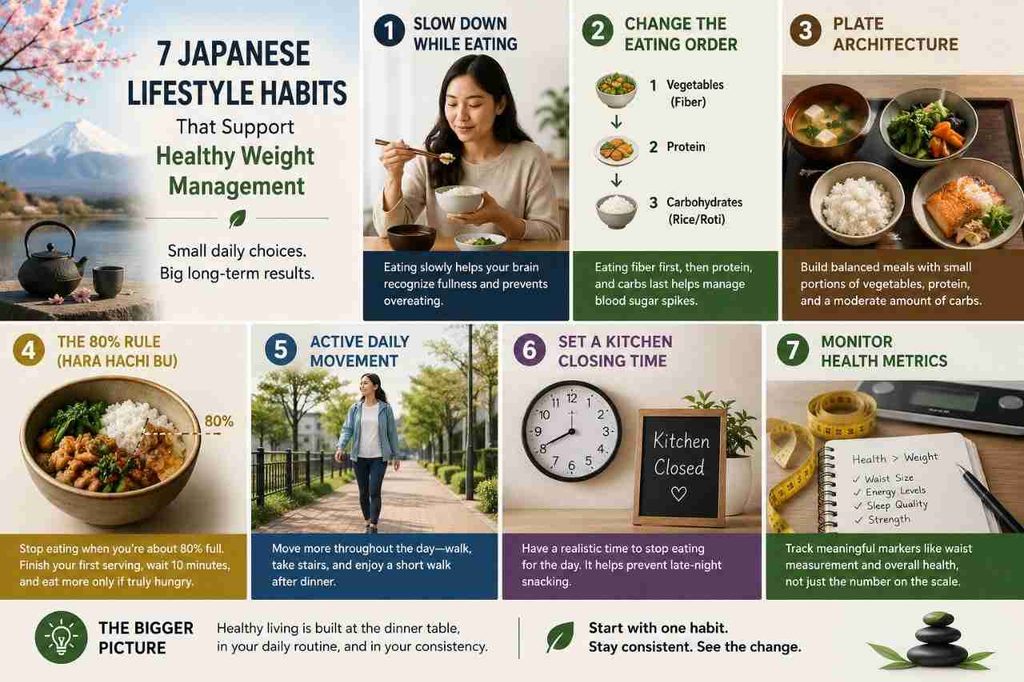
4. Practice the 80% Rule
A well-known Japanese eating principle is Hara Hachi Bu, which is often described as eating until you’re about 80% full rather than eating until you’re completely stuffed.
The idea is to stop before reaching that uncomfortable feeling of being completely full.
One practical approach is to finish your first serving and wait for a few minutes before deciding whether you actually need more.
If you’re still genuinely hungry, you can have another serving. But if the hunger has passed, you can stop.
This encourages you to distinguish between true hunger and simply wanting to keep eating.
5. Make Movement Part of Everyday Life
Exercise doesn’t always have to mean spending an hour in a gym.
Another important principle is incorporating movement naturally into your daily routine.
Simple activities can add up:
* Walking instead of taking a vehicle for short distances
* Taking the stairs
* Walking while running errands
* Standing and moving regularly during the day
* Taking a short walk after dinner
These activities may seem insignificant individually, but consistency matters.
Instead of thinking of exercise as something you do only during a scheduled workout, think of movement as something that belongs naturally in your everyday life.
6. Set a Kitchen Closing Time
Late-night snacking can easily become an unnoticed source of extra calories.
One way to manage this is to establish a realistic kitchen closing time.
This doesn’t mean you need to follow an extremely early or rigid cutoff. The important thing is to create a consistent routine that reduces unnecessary eating late at night.
Once dinner is finished and your kitchen is “closed,” shift your attention toward other activities—reading, relaxing, preparing for the next day, or getting ready for bed.
A consistent evening routine can make it easier to avoid eating simply because you’re bored or because food is available.
7. Monitor More Than Just Your Weight
The number on the weighing scale isn’t the only measure of health.
Your weight can fluctuate because of factors such as water retention, food intake, and other normal changes.
That’s why it can be useful to monitor additional measurements, such as waist circumference, along with other meaningful health indicators.
Tracking these changes can give you a broader picture of what’s happening with your body rather than making you overly focused on daily fluctuations on the scale.
The goal should not simply be to become lighter.
The bigger goal is to become healthier and metabolically fitter.
Healthy Living Begins With Everyday Choices
One of the most important lessons from these Japanese-inspired habits is that health isn’t built only inside a gym.
It is also built at the dinner table, in the kitchen, during your daily commute, and through the small decisions you make every day.
You don’t need to change everything at once.
In fact, trying to completely transform your lifestyle overnight can make it difficult to maintain the changes.
Instead, start with one habit.
For example, begin by changing your eating order. Once that becomes natural, introduce another habit—perhaps eating more slowly or taking a short walk after dinner.
Small habits become powerful when they are repeated consistently.
The Bigger Picture
Sustainable weight management isn’t about finding the most restrictive diet or the fastest way to lose weight.
It’s about creating a lifestyle that you can realistically maintain.
Eat mindfully.
Choose balanced portions.
Move regularly.
Avoid unnecessary late-night eating.
Pay attention to your health markers.
And, most importantly, stay consistent.
You don’t have to become perfect.
You simply have to make slightly better choices, day after day.
Start with one habit today. Let consistency do the rest.
*Note: These habits can support healthy eating and lifestyle patterns, but individual nutritional needs vary. If you have a medical condition or specific weight-management goal, it’s best to discuss your plan with a qualified healthcare professional.*
Join Whatsapp channel Kerala Homemaker
- 6 Japanese Habits That Can Turn Your Home Into a Peaceful Sanctuary

- 6 Everyday Hygiene Mistakes That Could Be Spreading Germs Around Your Home
- From a ₹15,000 Salary to Financial Independence: Arjun’s Inspiring Side-Business Journey
- 7 Japanese Lifestyle Habits That Can Support Healthy Weight Management
- 10 Thoughtful Rakhi Gift Ideas for Your Sister-in-Law | Rakhi Gift Ideas for Sister in Law
- Rakhi Messages|Rakshabandhan Quotes|Rakshabandhan 2026|Rakhi Wishes